
Examine the Vehicle's Past Record in France With Through VIN
Looking for an easy way to check the vehicle’s records? Use our France VIN Check and get the vehicle history report to examine the vehicle’s past ownership, mileage, warranty records, and much more!
Why You Need to Check VIN in France?
5 million
France has one of Europe’s largest used car markets, with millions of transactions annually. Historically, over 5 million used car transactions were recorded in 2022.
32.2%
Around 32.2 % of used cars imported into France come from Germany
28.5%
The number of second-hand vehicles in France was noted as damaged in a consumer report comparison (May 2021–May 2022).
What is a VIN Number?
A VIN, or Vehicle Identification Number, is a standardized 17-character code that uniquely identifies a specific vehicle. It is assigned during manufacturing and contains important details such as the brand, production country, body style, engine type, and the vehicle’s unique serial number. Even vehicles of the same model and year will always have different VINs.
In France, checking a VIN is particularly important due to the high volume of used vehicles imported from other EU countries. A France VIN check helps verify a vehicle’s true origin and can uncover key history details, including ownership records, accident history, theft alerts, or damage reported outside France.
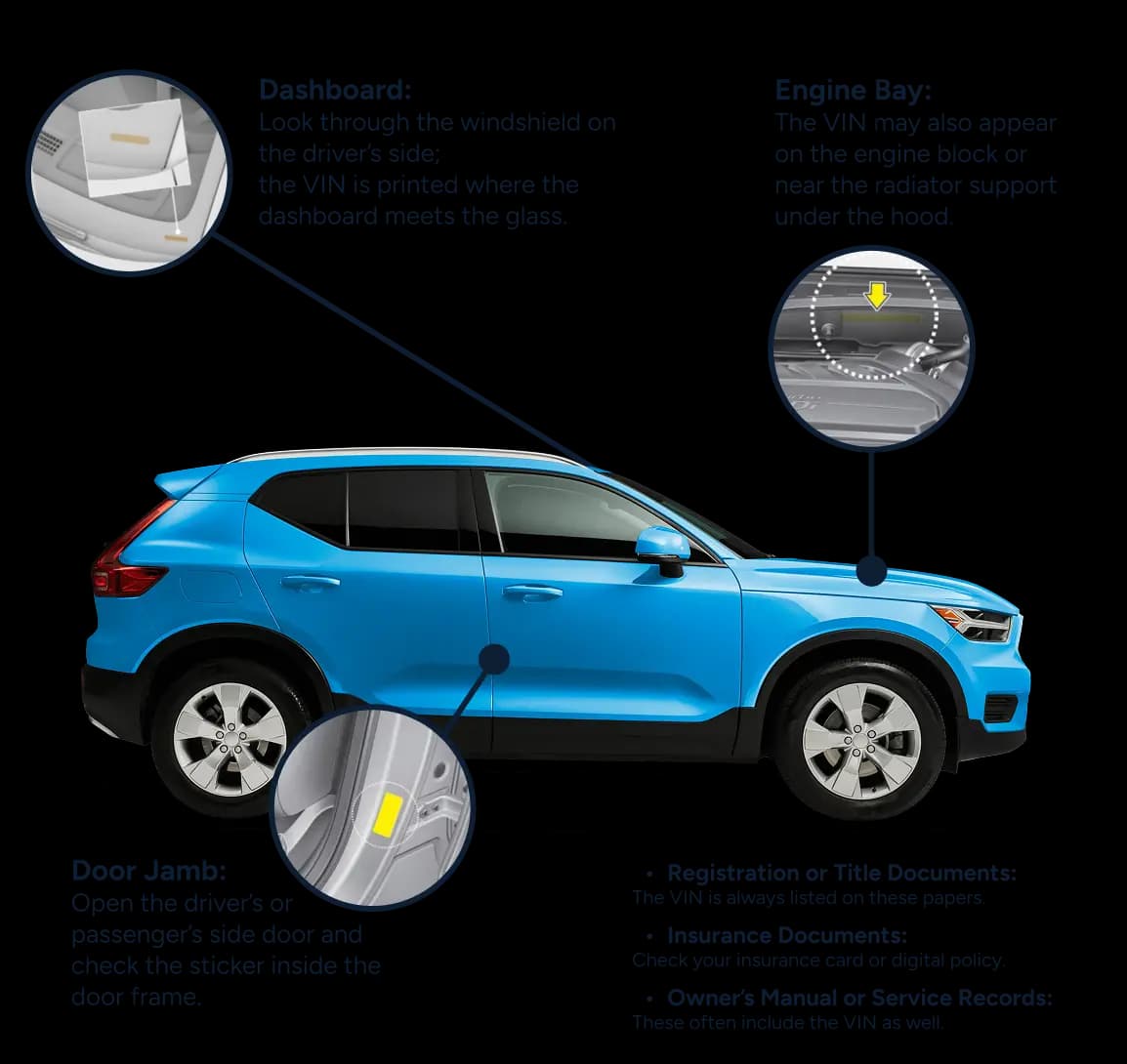
Where to Find the VIN on a Car
The VIN is permanently marked on the vehicle and listed across official documents. Checking it in more than one place helps confirm authenticity and detect any signs of alteration.
Dashboard
Look through the windshield on the driver’s side from outside the vehicle. The VIN is typically displayed on a metal plate or durable label positioned at the base of the dashboard.
Door Frame
Open the driver’s door and inspect the door pillar or latch area. A manufacturer sticker or plate here usually displays the VIN along with production details and weight specifications.
Engine Bay
Lift the bonnet and examine the firewall between the engine compartment and the cabin, or check the engine block. Many manufacturers stamp or securely attach the VIN in these areas for permanent identification.
Vehicle Documents
The VIN is also listed on official paperwork, including the registration certificate, insurance documents, ownership records, and import paperwork. Always make sure the VIN on the vehicle matches all documents exactly before finalizing a purchase.
What Information Can You Get From a France VIN Check?
A VIN number check in France provides a comprehensive digital footprint of a vehicle, offering essential transparency for navigating the French used car market. This report allows you to verify a car’s authenticity and legal standing before finalizing any transaction.
Vehicle Specifications and Origin
A French VIN report reveals the precise identity of the vehicle as it left the factory, ensuring the car matches its advertised description.
Factory Build Details
Access the original production data, including the specific manufacturing plant, paint codes, and factory-installed interior options. This ensures the car hasn’t been modified or “up-badged” over time.
Regional Market Value
Assess the vehicle’s value within the French market by comparing its original list price to current valuation trends in regions like Île-de-France or Auvergne-Rhône-Alpes.
Technical Specifications
Understanding the mechanical DNA of a vehicle helps you anticipate maintenance needs and performance capabilities.
Engine and Performance Data
Review critical data such as engine displacement, power output in kilowatts ($kW$) or horsepower, and Euro emissions standards, which are vital for Crit’Air certification in France.
Drivetrain and Transmission
Verify the specific gearbox configuration, whether it’s a traditional manual, an EAT8 automatic, or a dual-clutch system, along with the drive layout (FWD, RWD, or 4WD).
Legal Status & Vehicle Condition
In France, ensuring a vehicle is “gage” (liens) free and has a clean title is a mandatory step for any secure purchase.
HistoVec and Title Status
Check if the vehicle has a “certificat de non-gage,” which proves no administrative oppositions or thefts are preventing the transfer of the Carte Grise (registration certificate).
Odometer History (UTAC/OTC)
Review mileage records collected during mandatory Contrôle Technique (CT) inspections to detect if the odometer has been rolled back between testing intervals.
Lien Information
Financial transparency is crucial to avoid “hidden” debts that could lead to the seizure of the vehicle after purchase.
Outstanding Financing and Leases
Identify if the vehicle is still under an active LOA (Location avec Option d’Achat) or LLD (Location de Longue Durée) contract that could block legal ownership transfer.
Legal Claims and Administrative Bars
Find out if the French authorities have flagged the vehicle due to unpaid traffic fines, court orders, or if it has been declared a “Vehicule Gravement Endommagé” (VGE).
Accident & Damage History
Insurance data provides a window into the structural integrity of the car and any major repairs it has undergone.
Insurance Claim Records
Access records of past insurance claims filed in France to see if the vehicle was involved in significant collisions or weather-related damage, such as flooding.
Structural Integrity and Repairs
Understand the severity of past damages and whether the vehicle was cleared for the road by a certified automotive expert following major repairs.
Sales & Auction History
Tracking a car’s journey through various owners and dealerships provides context on how well it was maintained.
Ownership Transfers
See the timeline of how many times the vehicle has changed hands in France, which helps distinguish between a long-term family car and a frequently flipped vehicle.
French Auction Activity
Discover if the vehicle was ever sold through professional auction houses, which often indicates former fleet or corporate use.
How to Decode VIN in France
To decode the VIN in France and get a vehicle report, you just need to follow these simple steps.
Step 1: Enter the VIN
You can check on the driver’s side doorjamb or ask the seller to get the VIN. Then, write down on the form.
Step 2: Click "Search VIN"
After you’ve written down the VIN, click on the button to submit the form.
Step 3: Get a Detailed Vehicle History Report
Wait for 30 seconds to get the report generated. Then, examine the preview page. After that, you can proceed to payment to get the full vehicle history report in France.
Free vs. Paid VIN Check in France
Our free VIN check in France tool can be used to get the basic information of the vehicle, such as the specifications. However, if you need to get the complete information, you can use our paid VIN check service.
Information / Records | Free VIN Check | Paid VIN Check |
|---|---|---|
Year, make & model | ||
Engine type & size | ||
Transmission | ||
Drive type | ||
Fuel type | ||
Doors | ||
Horsepower & torque | ||
Detailed vehicle specs | ||
Technical specs | ||
Auction records | ||
Vehicle sales history | ||
Title and condition | ||
Accident records | ||
Theft records | ||
Lien and loan records |
The Importance of Checking the VIN Number in France
France possesses one of the most robust and regulated used-car markets in Europe, yet the high volume of cross-border trade, particularly from neighboring Spain, Italy, and Belgium, also poses significant risk. A VIN number check in France is a vital safeguard that replaces uncertainty with verified data, ensuring you don’t inherit a vehicle with a hidden past.
Buyers
For those looking to purchase a used vehicle in France, a VIN check serves as a digital “X-ray,” exposing details that a fresh coat of wax or a clean interior might hide.
Disclosure of Major Accident History
While a car may look pristine on a lot in Lyon or Paris, a VIN report can flag if it was ever recalled or was in an accident. This ensures you are aware of structural repairs or collisions that could compromise the safety and future resale value of the car.
Verification of Odometer Consistency
Mileage tampering, or “odometer rollback,” is a persistent issue in the secondary market. By accessing historical records from past Contrôle Technique (CT) inspections, buyers can verify that the mileage has increased logically over time, rather than mysteriously dropping before a sale.
Sellers
In a competitive French market, transparency is a powerful selling tool. Professional and private sellers alike use VIN reports to distinguish their listings from less-reputable options.
Acceleration of the Sales Process
When a buyer sees a transparent record of ownership and maintenance, they are significantly more likely to commit to a purchase quickly without extensive back-and-forth.
Validation of Premium Pricing
If you are selling a well-maintained vehicle with a low number of previous owners and a documented service history, a VIN check allows you to justify a higher-than-average asking price.
Why You Should Check a VIN in France
A France VIN check gives fast access to vehicle information relevant to both the local and EU markets. Whether a car is registered in France or imported, a VIN report helps uncover key details before you commit.
Comprehensive Vehicle Reports
Each report brings together accident history, ownership records, and registration data sourced from trusted French and international databases.
Easy-to-Use Platform
Simply enter the VIN to get started. The system is designed for private buyers, sellers, and automotive professionals.
Trusted and Update Data Source
Access vehicle information compiled from trusted sources, including vehicle registration authorities, auction platforms, insurance-related records, manufacturer databases, and other automotive data providers.
Instant Results
VIN results are generated within seconds, allowing you to review important information without unnecessary waiting.
Cost-Effective Insights
A France VIN check delivers more in-depth analysis than basic lookup tools, offering strong value with no hidden fees or access limitations.
Fully Private and Secure
Every VIN search is processed securely. Your personal information and search activity remain confidential and are never shared with third parties.
Tips Before Purchasing a Used Car in France
Buying a car in France requires specific administrative steps. Use these guidelines to verify the vehicle’s legal standing and ensure a smooth ownership transfer.
Mandatory Inspection (Contrôle Technique)
If the vehicle is more than four years old, the seller must provide a Contrôle Technique (CT) report. To be valid for a sale, the inspection must have been completed within the last six months. If the report indicates a "contre-visite" (re-inspection) is required, the certificate must be less than two months old.
Administrative Status (Certificat de Non-Gage)
The Certificat de Situation Administrative, commonly known as a "certificat de non-gage," is vital. This document proves the vehicle is not stolen, has no unpaid fines, and isn't being used as collateral for a loan. Ensure the seller provides a copy dated within the last 15 days.
Ownership Registration (Carte Grise)
The Carte Grise (registration certificate) is the car's identity card. Verify that the name on this document matches the seller’s identification perfectly. Upon sale, the seller must cross out the document, sign it, and write "Vendu le [Date/Time]" to officially hand over the vehicle.
Transfer Declaration (Certificat de Cession)
The sale is only official once both parties sign the Certificat de Cession. This form acts as the legal deed of sale. Once signed, the seller provides you with a copy and a "code de cession," which you will need to register the car in your name online via the ANTS website.
How a €5,500 "Bargain" Turned Out to Be a Salvage Car
Thomas Leclerc found a 2005 Renault Clio listed at €5,500. It seemed suspiciously cheap, but the dealer promised it had a clean title and no accident history. Before signing the paperwork, Thomas decided to run a VIN check.
What the VIN Check Found
- UK insurance auction vehicle
- Front-end collision damage
- Damage ratio: 83%
- Repair cost: €7,800+
The Numbers
Asking Price
€5,500
Actual Value
€1,500–€2,000
Would Have Lost
€4,000–€6,500
Result: Thomas walked away. Two weeks later, he found a genuine Clio at fair market price. The VIN check saved him from buying a salvage vehicle disguised as a clean car.
Don't trust "clean title" claims. Run a VIN check and see the complete history.
Run VIN Checks in Other Countries
No matter where a car is from, our VIN check works across Europe to help you verify imported vehicles.
Get a VIN Check Before Buying a Used Car in France
Knowing the car’s past is important. Get the full car report in France to ensure it has no hidden damage and has a clear odometer reading
FAQs About France VIN Check
How to read a European VIN?
Reading a European Vehicle Identification Number (VIN) means decoding a standardized 17-character code that often begins with letters from S to Z, indicating European manufacture. The first three characters form the World Manufacturer Identifier (WMI), followed by a five-character Vehicle Descriptor Section (VDS), and ending with the Vehicle Identifier Section (VIS), which includes the model year and the vehicle’s unique serial number.
Are there VIN numbers in Europe?
Yes, vehicles in Europe are assigned Vehicle Identification Numbers (VINs), which are unique 17-character codes used for identification and registration. In German-speaking countries, the VIN is known as the Fahrzeug-Identifikationsnummer (FIN) and follows the ISO 3779 standard. It is commonly stamped on the chassis, located in the engine bay, or visible near the dashboard or windscreen.
Do cars in Europe have VIN numbers?
Yes, all cars in Europe have Vehicle Identification Numbers (VINs), which are mandatory 17-character alphanumeric codes required for vehicle registration and traceability. Standardised under ISO guidelines and enforced by EU regulations, VINs are permanently stamped on the chassis, displayed on the dashboard, and recorded on official registration documents.
How do I check a car's history in France?
In France, vehicle history checks are commonly done through HistoVec. This government-backed platform provides details on technical inspections (MOT) and administrative status using the licence plate and registration certificate. For a more detailed vehicle overview, including accident records, auction data, damage history, and warranty details, use our France VIN Check
What is the most stolen car in France?
The Renault Clio IV ranks among the most stolen cars in France, with over 2,200 thefts reported each year in 2023 and 2024. Other commonly stolen models include the Peugeot 3008 II; vehicles like the Mégane and Peugeot 208 rank after. Use our France VIN Check and get the report to see theft records.