
Check a Vehicle's Past Records With a Switzerland VIN Check
Before you decide to purchase a used vehicle in Switzerland, it is important to run a VIN check and get the vehicle history report. Check the vehicle’s records, like accident history, auction, odometer reading, and more!
Why You Should Check VIN in Switzerland?
1.6%
Switzerland has relatively low odometer tampering compared with many European countries, at around 1.6 %.
58.9%
In Swiss data from the transparency index analysis, a high share of vehicles (~58.9 %) had recorded past damage when checked
55%
More than 55 % of imported used cars in Switzerland come from Germany.
What is a VIN Number?
A Vehicle Identification Number, or VIN, is a unique 17-character code assigned to every vehicle at the time of manufacture. It identifies the manufacturer, production plant, and the vehicle’s individual serial number. Even cars of the same make and model never share the same VIN.
In Switzerland, checking a VIN is particularly important because many used vehicles are imported from neighbouring countries such as Germany, France, and Italy. A Switzerland VIN check helps buyers confirm the vehicle’s origin and review its background, including ownership history and any records of accidents, theft, or write-offs registered abroad.
Where to Find the VIN on a Car?
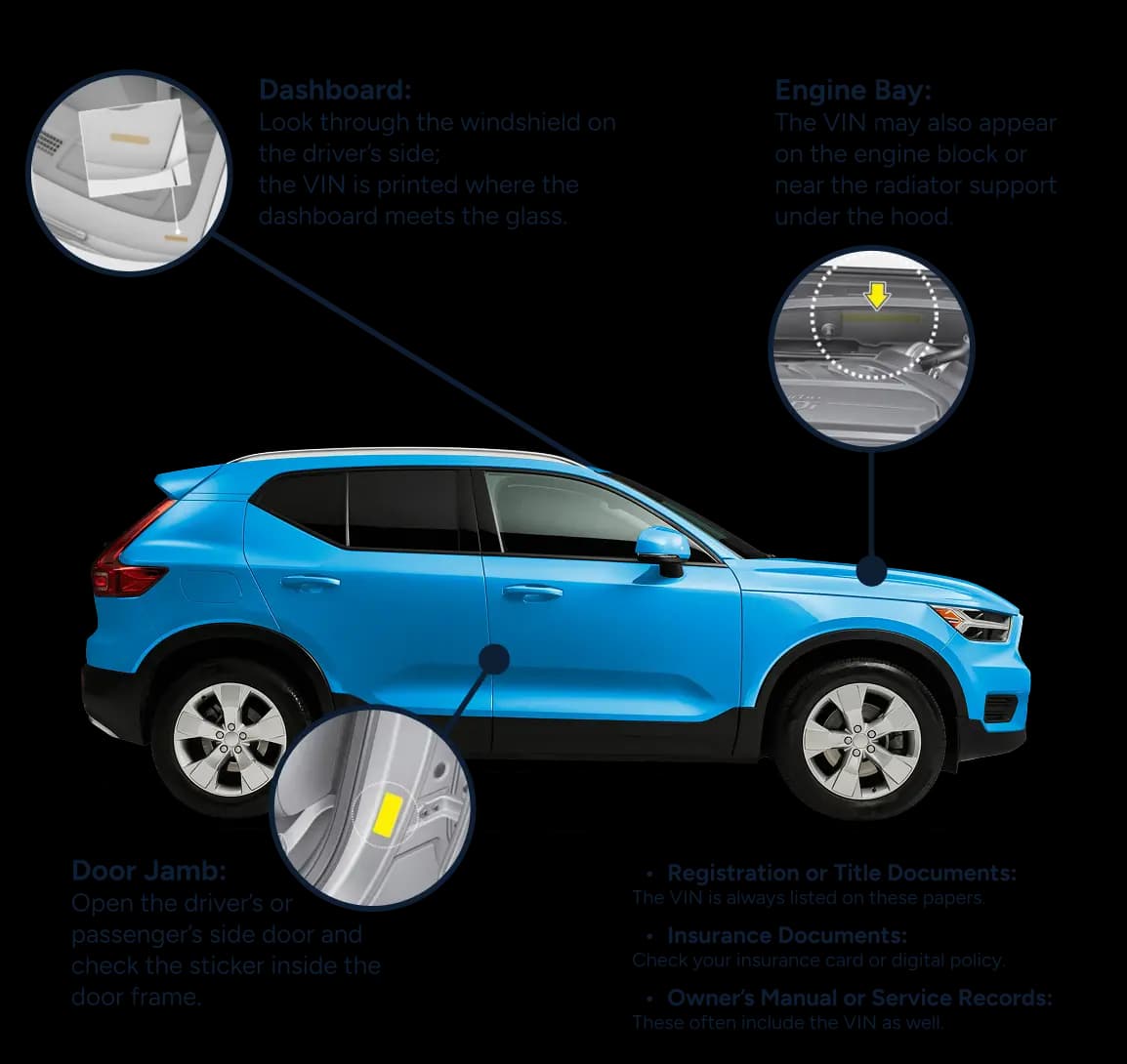
The VIN is displayed in several fixed locations on the vehicle and listed on official documents. Checking more than one location helps confirm accuracy and detect possible tampering.
Dashboard
Look at the lower corner of the driver’s side dashboard where it meets the windshield. The VIN is usually shown on a metal plate or label that can be read from outside the vehicle.
Door Jamb
Open the driver’s door and inspect the sticker or plate on the door frame near the locking area. This section often displays the VIN along with manufacturing and compliance details.
Under the Hood
Lift the hood and check the firewall between the engine bay and the cabin, or inspect the engine block. Many manufacturers permanently stamp or label the VIN in this area.
Vehicle Documentation
The VIN also appears on key documents such as the Swiss vehicle registration certificate (Fahrzeugausweis / permis de circulation), insurance papers, and import records. Always make sure the VIN on the vehicle matches the information shown on these documents.
What Information Can You Get From a Switzerland VIN Check?
Running a VIN check in Switzerland provides access to a detailed vehicle history report that covers both the car’s background and its current status. This information helps reduce risk and supports more confident buying or selling decisions.
Detailed Vehicle Specification
Review key factory details such as the vehicle’s country of manufacture, original list price, fuel type, drivetrain layout, and other essential specifications.
Detailed Build Info
Examine technical build data, including engine displacement, transmission configuration, and factory-installed features, to confirm the vehicle matches the seller’s description.
See the Prices
Compare the original MSRP with current Swiss market values to assess whether the asking price is reasonable and aligned with similar vehicles.
Technical Specifications
Access mechanical and performance-related information that explains how the vehicle is designed to perform under normal driving conditions in Switzerland.
Engine Details
Check engine size, configuration, power output, and manufacturer-rated fuel efficiency figures based on official specifications.
Transmission Type
Confirm whether the vehicle is equipped with a manual or automatic transmission, including the number of gears and drivetrain setup.
Title and Vehicle Condition
Understand the vehicle’s legal standing and overall condition to avoid registration delays, ownership disputes, or unexpected issues after purchase in Switzerland.
Title Status
See whether the vehicle has a clean title or carries records such as salvage, rebuilt status, or other legal restrictions.
Odometer Records
Review dated mileage entries to identify inconsistencies or potential signs of odometer manipulation.
Lien and Loan Information
Identify any financial obligations associated with the vehicle that could complicate or prevent a smooth ownership transfer.
Outstanding Loans
Check for unpaid vehicle loans or active financing agreements still linked to the car.
Legal Claims
Review court claims, liens, or other legal holds that may affect ownership rights or registration eligibility.
Accident and Damage Records
Find out whether the vehicle has been involved in reported accidents or sustained damage during its lifetime.
Collision Reports
Access insurance or police records related to reported accidents involving the vehicle.
Damage Severity
Understand how serious each incident was and whether repairs were documented after the damage occurred.
Sales and Ownership History
Track how ownership has changed over time to identify unusual resale behaviour or frequent transfers.
Previous Owners
See how many owners the vehicle has had and the timeline of ownership changes.
Price History
Review past sale prices to determine whether the current listing aligns with historical market trends.
Auction Records
Check whether the vehicle has appeared in dealer or wholesale auctions, which may indicate fleet use or trade-in history.
Auction Dates and Locations
See when and where the vehicle was sold at auction and under what conditions.
Auction Condition Photos
Examine available auction images to assess the vehicle’s condition at the time of sale.
How to Check a VIN Number in Switzerland?
Checking the VIN number in Switzerland is easy; follow these instructions to get it done in under a minute.
Step 1: Enter the VIN
Check in the vehicle’s driver’s side doorjamb or on the documentation to have the VIN. Then, write down on the form above.
Step 2: Click "Search VIN"
After you’ve written down the VIN, you have to click on the button to submit the form. Then, wait for seconds.
Step 3: Get a Detailed Vehicle History Report
Wait for seconds to get the report generated, then examine the preview page. After that, proceed to payment to get the report generated.
Free vs. Paid VIN Number in Switzerland
A free VIN check in Switzerland allows you to view basic vehicle information such as specifications, estimated market value, last recorded mileage, and country of origin. For deeper insights, including complete history records, a paid VIN check provides more comprehensive details.
Information / Records | Free VIN Check | Paid VIN Check |
|---|---|---|
Year, make & model | ||
Engine type & size | ||
Transmission | ||
Drive type | ||
Fuel type | ||
Doors | ||
Horsepower & torque | ||
Detailed vehicle specs | ||
Technical specs | ||
Auction records | ||
Vehicle sales history | ||
Title and condition | ||
Accident records | ||
Theft records | ||
Lien and loan records |
The Importance of Checking the VIN Number in Switzerland
Checking a vehicle’s VIN in Switzerland is a crucial step before buying or selling a car. It helps confirm official records, reduces uncertainty, and protects both buyers and sellers from costly surprises after the transaction.
Buyers
For car buyers in Switzerland, a VIN check offers insight that goes far beyond what a short inspection or test drive can reveal.
Identify Hidden Damage
A VIN lookup can uncover records of previous accidents, structural repairs, or serious damage that may not be immediately visible, helping buyers avoid vehicles with unresolved issues.
Verify Odometer Accuracy
Mileage inconsistencies still appear in the used car market. Reviewing historical mileage entries helps confirm whether the displayed odometer reading reflects the vehicle’s actual usage.
Sellers
Sellers in Switzerland can also benefit from reviewing a VIN report before listing a vehicle, especially when dealing with cautious or well-informed buyers.
Close Deals Faster
Providing a verified vehicle history report upfront addresses common buyer concerns early, reducing repeated questions and often speeding up negotiations.
Set a Fair Price
Clear information about ownership history, condition, and market data allows sellers to price the vehicle realistically while remaining competitive.
Why Choose Our Switzerland VIN Check Tool
Our Switzerland VIN check tool is built to provide fast and reliable access to vehicle data relevant to the Swiss market. Whether the vehicle is registered in Zurich, Geneva, Bern, or elsewhere, it helps uncover key records before any commitment is made.
Complete Vehicle Reports
Each report includes important history details such as accident records, ownership changes, and title-related information, sourced from trusted Swiss and European databases.
User-Friendly System
Simply enter the VIN into the search field above to get started. The platform is designed for ease of use and works well for both first-time buyers and experienced automotive professionals.
Reliable Data Sources
All reports are compiled using verified and reputable data sources to ensure accuracy, consistency, and dependable results.
Fast Results
Vehicle history reports are typically generated in around 30 seconds, allowing users to review critical information without unnecessary delays.
Affordable Pricing
Our Switzerland VIN check offers strong value by delivering more detailed insights than many basic tools, without adding unnecessary cost.
100% Private and Secure
Every VIN search is handled securely. Personal information and lookup activity remain confidential and are never shared with third parties.
Tips Before Purchasing a Used Car in Switzerland
Buying a used car in Switzerland requires more than a quick inspection. Checking inspection records, service history, and vehicle condition carefully can help you avoid hidden costs and unexpected problems after purchase.
Mileage ManipulCheck the MFK Inspection Statusation
The Motorfahrzeugkontrolle (MFK) is one of the most important checks. A recent MFK inspection, ideally within the last year, usually indicates better overall condition. If it is outdated, negotiate the price or request a new inspection before purchase.
Review Service History and Documents
Always inspect the Serviceheft (service booklet) for consistent maintenance, preferably from authorised or reputable garages. Make sure the Fahrzeugausweis (registration document) is available and review the ownership history for any irregular changes.
Conduct a Thorough Physical Inspection
Inspect the vehicle in daylight for signs of rust, accident repairs, or uneven paintwork. Check tyre wear, suspension condition, and listen carefully for unusual engine or exhaust noises during idle and acceleration.
Take a Proper Test Drive
Test the brakes, steering response, and acceleration under different driving conditions. Ensure the gearbox shifts smoothly and confirm that all electrical features, including air conditioning, windows, and infotainment systems, function correctly.
Run VIN Checks in Other Countries
No matter where a car is from, our VIN check works across Europe to help you verify imported vehicles.
FAQs on Switzerland VIN Check
Can I check my VIN for free?
Yes, you can check the VIN for free by using our free VIN check service. On our free service, you can get the detailed information on the car’s year, make, model, transmission, drive type, and more.
What is MFK Switzerland?
MFK (Motorfahrzeugkontrolle) in Switzerland is a compulsory vehicle inspection that confirms a car meets legal safety and emissions standards. Managed by cantonal authorities, it checks systems such as brakes, steering, lights, and exhaust emissions. Vehicles are usually inspected five years after first registration, then every three years, and every two years thereafter.
Where can I verify a VIN number?
A VIN (Vehicle Identification Number) can be checked online for free through trusted platforms such as Vehicle History EU to view build specifications, theft or salvage flags, and basic history details. More advanced checks help confirm a vehicle’s legitimacy, identify recalls, and uncover reported accident records.
What to know before driving in Switzerland?
Driving in Switzerland means following strict traffic rules. Drivers must display a CHF 40 motorway vignette, use daytime running lights, and comply with a low alcohol limit of 0.05 percent BAC. Traffic keeps right, overtaking is done on the left, speed limits are lower than in many countries, and speed cameras are widely used.
How do tourists pay tolls in Switzerland?
Tolls in Switzerland are paid through a mandatory motorway vignette rather than toll booths. The CHF 40 sticker is valid for 14 months, from December to January, and covers all national motorways. It is available as a physical sticker or a digital e-vignette linked to the vehicle’s license plate.