Key Takeaways
- Check your VIN, window sticker, vehicle documents, and manufacturer specifications to identify your car's engine.
- Engine information can include displacement, fuel type, cylinder count, engine configuration, aspiration, and other technical specifications.
- Compare the VIN and engine details across multiple sources if the information does not match.
- Remember that VIN-based records may show the vehicle's factory configuration and cannot alone confirm which engine is physically installed today.
Not sure what engine your car has? You can find the engine size, type, and other specifications by checking the vehicle’s VIN, owner’s manual, registration documents, manufacturer information, or window sticker.
You can use the Vehicle History EU service to get a window sticker by VIN to examine the vehicle’s engine details and other information. Knowing the car’s engine information helps when buying or selling a used car, ordering parts, and verifying if the vehicle matches its advertised specifications to ensure you do not get scammed.
What Information Identifies a Car's Engine?
A car engine can be identified in several ways. On a window sticker, you can easily get detailed information about the car’s engine, displacement, number of cylinders, engine code, aspiration, or other technical details. Here is a detailed explanation of what you can expect in the window sticker’s engine detail section:
Engine Size
The engine size refers to the engine displacement, which is usually measured in litres or cubic centimetres (cc). For example, a vehicle may have a 0.999-litre (999 cc), 1.5-litre, 2.0-litre, or 3.0-litre engine.
Engine Type
Engine type describes the engine's configuration. Common examples include inline-three, inline-four, V6, petrol, and diesel engines.
Engine Code
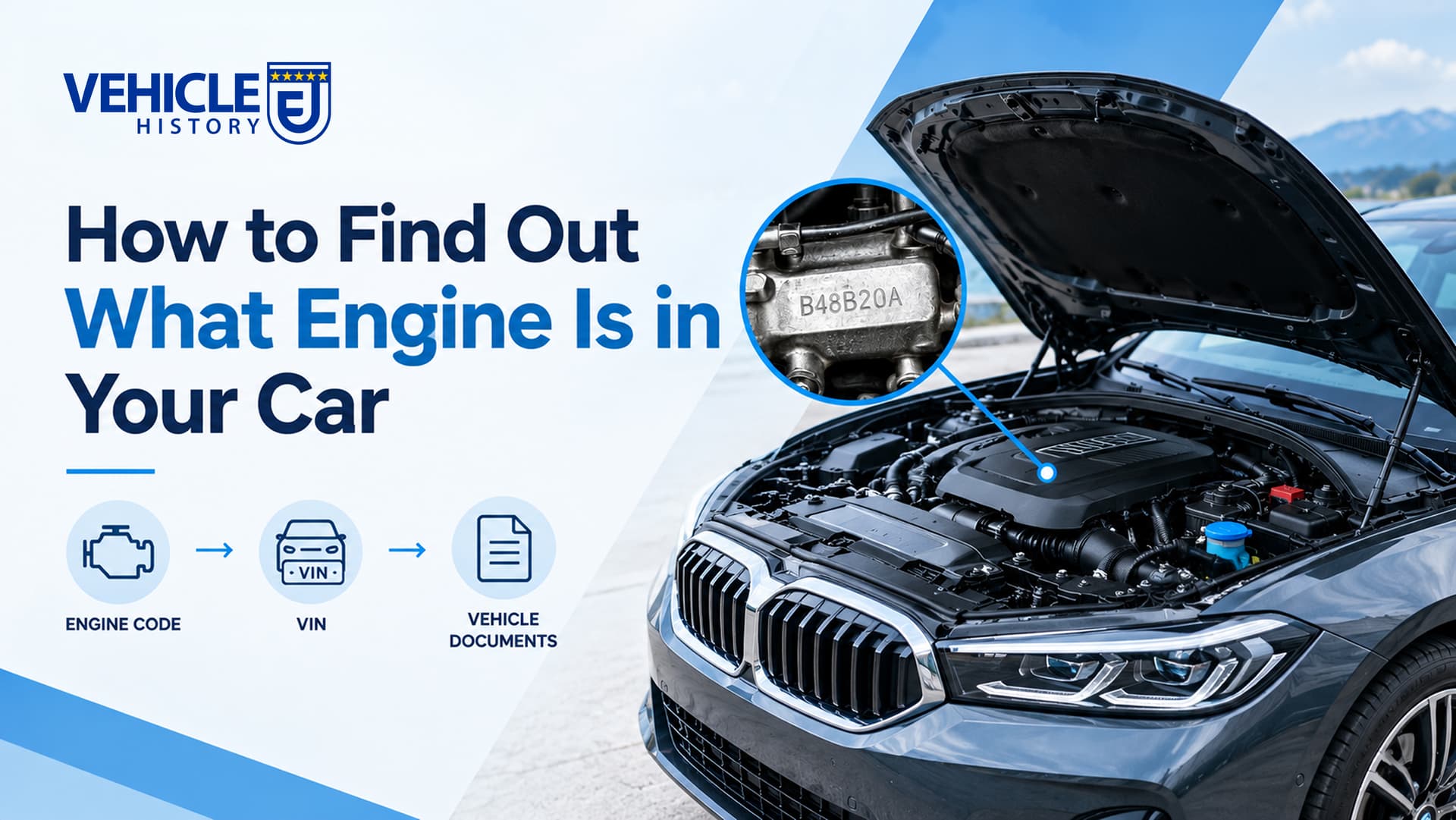
An engine code is a manufacturer-specific identifier that is assigned to a particular engine family. The engine code helps to distinguish between different engines offered for the same vehicle and can be useful when checking specifications or finding compatible replacement parts.
Number of Cylinders
The number of cylinders describes how many cylinders are in a conventional internal combustion engine. Common configurations include three-, four-, six-, and eight-cylinder engines.
Engine Configuration
The engine configurations can include more specifications that describe how the engine is designed and installed by the manufacturer. It includes the engine's position, number of valves, bore, and stroke.
Aspiration
Aspiration describes how air enters the engine. An engine may be naturally aspirated or use forced induction, such as a turbocharger or supercharger. Some specifications provide additional details about the setup, such as a turbocharged engine with an intercooler.
How to Find Your Engine Size
There are a few ways to find the car’s engine size, and it is usually listed in litres or cubic centimetres (cc). If you need to confirm the engine size in your car, you can check the vehicle's window sticker, documents, or manufacturer specifications.
Check the Window Sticker
The window sticker shows complete specifications associated with the vehicle’s VIN, including engine size or displacement where the information is available. It also lists the vehicle's trim, powertrain, transmission, and other factory specifications.
Check the Vehicle Documents
Your vehicle documents may list the engine's capacity or displacement. Check the engine-capacity field and compare it with the VIN and other vehicle details to make sure the information corresponds to your car.
Check the Manufacturer's Specifications
You can also find engine size by checking the manufacturer's specifications for your vehicle. Start with the make, model, and model year, then identify the correct trim and powertrain because the same model can be offered with different engines.
Understanding Your Car's Engine Type
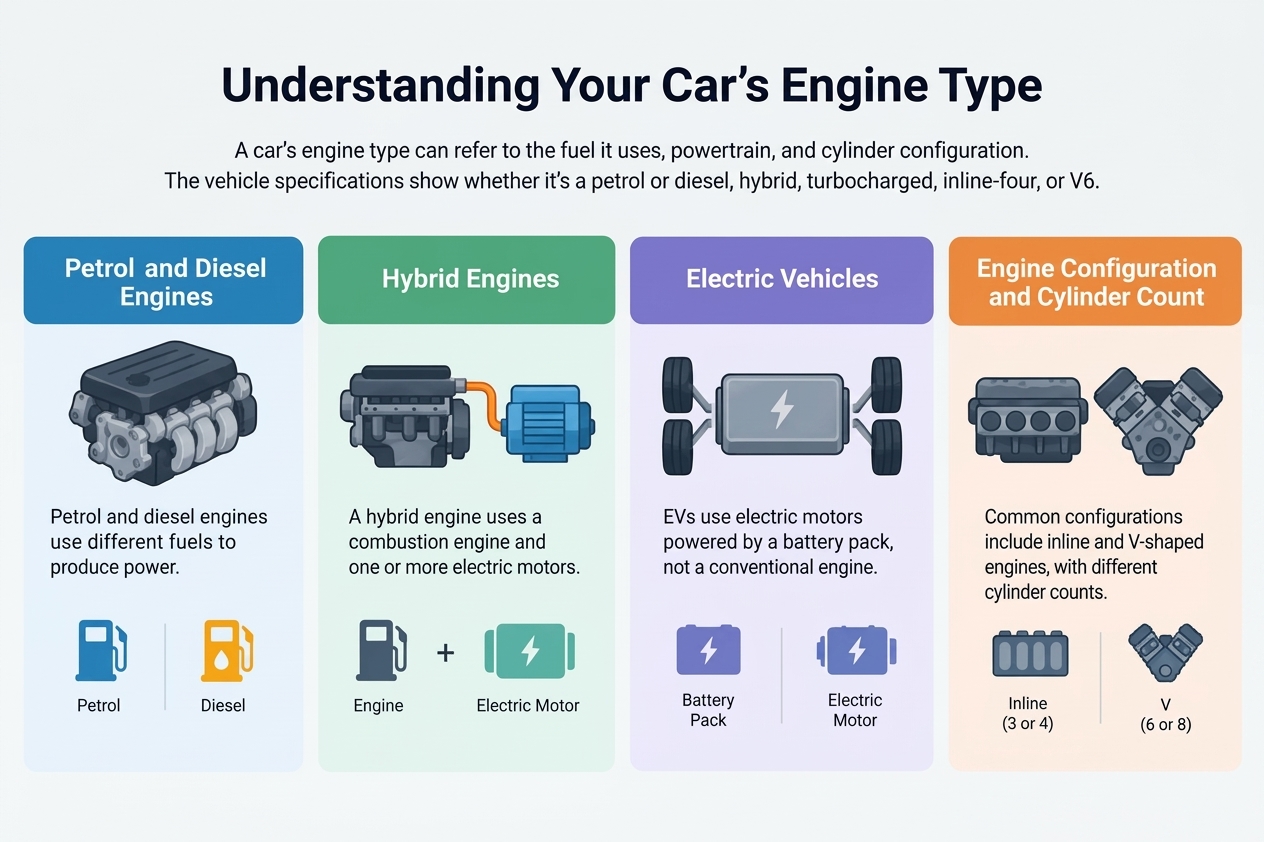
A car’s engine type can refer to different characteristics, including the fuel it uses, powertrain, and its cylinder configuration. The vehicle specifications show whether the vehicle describes its engine as petrol or diesel, for example, while also identifying it as a hybrid, turbocharged, inline-four, or V6.
Petrol and Diesel Engines
Petrol and diesel engines are conventional internal-combustion engines that use different fuels to produce power. The same model can be available with different petrol or diesel engines, so checking the model year, trim, and VIN can help identify the specific engine fitted to the vehicle.
Hybrid Engines
The hybrid engine combines an internal combustion engine with one or more electric motors. The powertrain depends on the vehicle; it is usually described as a hybrid or plug-in hybrid (PHEV).
Electric Vehicles
Electric vehicles (EVs) do not use a conventional internal-combustion engine. Instead, they use electric motors powered by a battery pack. The vehicle specifications list the number and type of motors, battery capacity, power output, and its drivetrain rather than traditional engine specifications.
Engine Configuration and Cylinder Count
Common configurations include inline engines, such as inline-three and inline-four, and V-shaped engines, such as V6 and V8. Cylinder count refers to the number of cylinders, which can help distinguish between different engine options offered for the same vehicle.
Should You Check What Engine Your Car Has?
Yes. Knowing exactly what engine your car uses can help you verify its configuration, describe it accurately, and find information that applies to the specific vehicle. Make sure you understand the engine details to avoid making mistakes when buying or selling a used car, ordering parts, or comparing vehicle specifications.
Buying a Used Car
Checking the engine can help you confirm that the vehicle matches the seller’s description and the vehicle’s specifications. This can be particularly useful when a model is available with multiple engine options.
Compare the Advertised Engine
You can check the engine size, fuel type, cylinder count, and other listed specifications to compare against the seller’s description. Make sure there are no differences between the available vehicle records; if so, then further investigation is required.
Match the VIN and Vehicle Records
You can use the VIN to compare the vehicle's engine with the window sticker, history records, and documents. This can help determine whether the advertised configuration corresponds with the vehicle's recorded information.
Selling a Car
Understanding a car’s correct engine specifications can help you create more accurate listing descriptions. Engine size, fuel type, and other configuration details can affect how buyers search for and compare vehicles.
Provide Accurate Engine Details
Write down the correct engine size, fuel type, cylinder count, and other relevant specifications rather than relying on baseless assumptions.
Match the Vehicle's Records
Compare the information in your listing with the VIN, vehicle documents, and available manufacturer or window sticker information. Consistent specifications can make it easier for potential buyers to understand the vehicle being advertised.
Ordering Replacement Parts
Engine specifications can affect whether a replacement part is compatible with your vehicle. The same model may use different engines, transmissions, or components depending on its year, trim, and market.
Check the Engine Specification
Before you pay for anything, examine the engine size, engine code, and model year before you order a part for your vehicle. Knowing the engine helps you narrow down the correct engine components.
Match the Part to the VIN
If possible, use the VIN with engine information to verify compatibility. VIN-based information can help distinguish your vehicle from other configurations that share the same model name.
Checking Vehicle Specifications
Engine information can help you compare different versions of a vehicle and understand specifications that may affect how it is equipped and operated. This can include fuel requirements, emissions information, drivetrain, and other powertrain characteristics.
Compare Different Configurations
Compare the engine size, fuel type, cylinder count, and other factors when you check a vehicle with different trims or model years. This can help explain why two vehicles with the same model name may have different specifications.
Check Fuel and Emissions Information
Engine and powertrain details help you find the appropriate fuel type and review the related emission specifications. Don’t forget to check the vehicle specifications when comparing fuel economy, running costs, or vehicle requirements.
Find Engine Size Information With VIN
Finding out what engine is in your car can be as simple as checking the VIN, vehicle documents, manufacturer specifications, or window sticker. Engine size, fuel type, cylinder count, and other specifications can help you identify the vehicle's configuration and make sure the information matches the car you are researching. If different sources show conflicting information, compare the VIN first and then check the model year, trim, and available records.
FAQs on How to Find Engine Size With VIN
How do I find out what engine is in my car?
You can find engine details by entering your vehicle's 17-digit VIN into a vehicle history or VIN lookup service, which may provide available engine specifications.
Can I find my engine size without the VIN?
Yes, you can find your engine size without the VIN by checking the vehicle's documents, window sticker, owner's manual, or manufacturer specifications. The engine itself may also have identifying information.
Can a window sticker tell me what engine I have?
Yes, a window sticker may show the engine fitted or specified for your vehicle, including details such as engine size, type, and other available powertrain specifications.
How do I find my engine code?
You may be able to find your engine code through VIN-based vehicle information, manufacturer documentation, or markings on the engine itself. The exact location and availability of an engine code vary by vehicle.
Does engine size tell me how powerful my car is?
No, engine size does not directly determine how powerful a car is. Horsepower and performance also depend on factors such as engine design, turbocharging, tuning, and the vehicle's overall powertrain.